

FL-41 Tinted Lenses, Auburn NSW
FL-41 Glasses for Blepharospasm
Involuntary eyelid spasm and light sensitivity: a randomised controlled trial supports FL-41 tinted lenses for blepharospasm management.
A randomised controlled trial published in Ophthalmology, the journal of the American Academy of Ophthalmology, found significant improvements in blink frequency, fluorescent light sensitivity, and blepharospasm severity in patients wearing FL-41 tinted lenses. Dr Zobaida Tahiri, therapeutically endorsed optometrist, provides clinical assessment and precision lens fitting at our Auburn NSW practice.
What Is Blepharospasm?
Blepharospasm is a neurological movement disorder characterised by involuntary, repetitive spasms of the muscles that close the eyelid. The most common form, benign essential blepharospasm (BEB), is a type of focal dystonia that can progress from intermittent increased blinking to prolonged uncontrolled eyelid closure, causing significant functional visual disability.
Light sensitivity (photophobia) is one of the most prominent and disabling features of blepharospasm for many patients. Bright environments, fluorescent lighting, glare, and outdoor light can dramatically increase spasm frequency and severity. For some patients, photophobia is severe enough to cause functional blindness in brightly lit environments despite intact visual function.
A related condition, Meige syndrome, involves involuntary spasms extending to the lower face, jaw, tongue, and neck muscles alongside blepharospasm. This broader cranial dystonia also frequently involves significant light sensitivity, and the same approach to managing the photophobic component applies.
Blepharospasm is distinct from benign myokymia (eyelid twitching), which is common and typically self-limiting. True blepharospasm involves both eyelids, is progressive without treatment, and warrants neurological or specialist evaluation alongside optometric assessment.
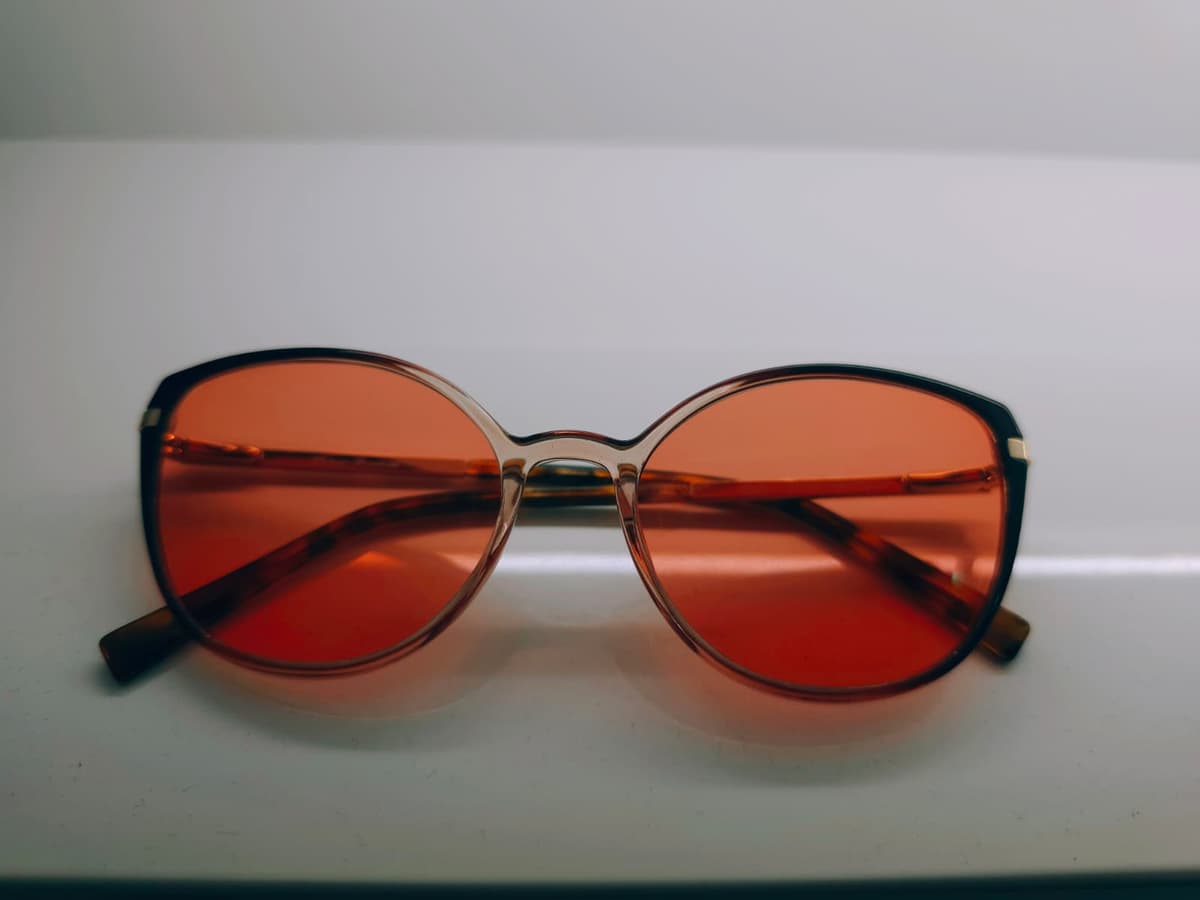
How FL-41 May Help with Blepharospasm
The relationship between specific wavelengths of light and eyelid spasm is not coincidental. Understanding the mechanism helps explain why FL-41 is the studied intervention, not simply any tinted lens.
The 480-520nm Pathway
The retina contains specialised cells called intrinsically photosensitive retinal ganglion cells (ipRGCs), which contain the photopigment melanopsin. These cells are maximally sensitive to blue-green light in the 480 to 520 nanometre range, which corresponds to the wavelengths most abundant in fluorescent and LED lighting. In blepharospasm, this pathway appears to be sensitised, with normal light levels triggering abnormal neural activity that drives the reflex arc responsible for eyelid spasm.
The Same Mechanism as Migraine Photophobia
The ipRGC pathway implicated in blepharospasm-related light sensitivity is the same pathway central to migraine photophobia. This shared mechanism explains why FL-41, originally developed for migraine management, has demonstrated effectiveness in blepharospasm research. By selectively filtering the 480 to 520nm band, FL-41 lenses reduce the specific input that drives this sensitised reflex, without darkening the visual environment to the degree that causes dark-adaptation rebound.
Why Not Just Wear Dark Sunglasses?
Many patients with blepharospasm intuitively reach for very dark sunglasses indoors. While this can provide short-term relief, wearing very dark lenses in indoor environments causes the visual system to dark-adapt, which subsequently lowers the threshold for light sensitivity when lenses are removed. This paradox can worsen photophobia over time. FL-41 lenses filter the problematic wavelength band rather than simply reducing overall light, making them more appropriate for prolonged indoor use.
Complementary to Existing Treatment
FL-41 glasses are used alongside, not instead of, established blepharospasm treatments such as botulinum toxin injections. The glasses may help extend the period of symptomatic relief between injection cycles by reducing the environmental light triggers that worsen spasm frequency. Patients with residual photophobia between treatment cycles may benefit from ongoing FL-41 lens wear.
The Clinical Evidence
The evidence for FL-41 in blepharospasm is grounded in a peer-reviewed randomised controlled trial, the highest level of individual study evidence in clinical research.
Randomised Controlled Trial
Blackburn MK et al., Ophthalmology, 2009
A randomised controlled trial published in Ophthalmology, the journal of the American Academy of Ophthalmology, examined the effect of FL-41 tinted lenses on patients with benign essential blepharospasm. The study found significant improvements in blink frequency, fluorescent light sensitivity, overall light sensitivity, and blepharospasm frequency and severity in the FL-41 lens group compared to control lens wearers.
This trial is significant because it used a randomised controlled design, allowing a direct comparison between FL-41 tinting and a control condition. The improvements observed across multiple outcome measures, including both objective (blink frequency) and subjective (light sensitivity severity) endpoints, provide a clinically meaningful evidence base for the use of FL-41 lenses as part of blepharospasm management.
Limitations and Clinical Context
FL-41 lenses are not a treatment for the dystonia underlying blepharospasm. The evidence supports their use in managing the photophobic component of the condition, which can be a significant driver of functional disability. They should be considered as part of a broader management plan that may include botulinum toxin injections, neurological review, and other supportive measures.
Individual response to FL-41 lenses varies. A clinical consultation allows Dr Tahiri to assess your specific pattern of light sensitivity, the environments that most worsen your symptoms, and whether FL-41 lenses or an alternative tint density is most appropriate for your situation.
What to Expect at Your Consultation
Dr Zobaida Tahiri provides a focused clinical assessment for patients with blepharospasm and associated light sensitivity at our Auburn NSW practice.
History and Assessment
Dr Tahiri will take a comprehensive history of your blepharospasm, including onset, severity, current treatments, and the environments that most worsen your light sensitivity. Relevant ocular health findings will be documented.
Tint Assessment
FL-41 lenses are available in different densities. Your consultation will include a practical assessment to identify the most appropriate tint density and lens format for your daily environments. Prescription requirements will also be confirmed.
Lens Dispensing and Follow-Up
Glasses can be ordered in-clinic with your prescription or in non-prescription format. Dr Tahiri provides guidance on appropriate wearing patterns, environments where lenses are most beneficial, and expectations for symptom improvement.
Frequently Asked Questions
Common questions about FL-41 glasses for blepharospasm and light sensitivity.
What is blepharospasm?
Can FL-41 glasses help blepharospasm?
What does the research show for blepharospasm and FL-41?
Are FL-41 glasses available with my prescription?
Does the eye examination cost anything?
Is blepharospasm related to Meige syndrome?
Will FL-41 glasses replace my botulinum toxin injections?
Disclaimer: FL-41 lenses are precision-tinted optical lenses, not a therapeutic device. They are not a substitute for medical management. Results vary between individuals. Always consult your treating clinician.
Book Your Blepharospasm Assessment
Dr Zobaida Tahiri, therapeutically endorsed optometrist, provides a focused clinical assessment for blepharospasm and associated light sensitivity at our Auburn NSW practice. Prescription FL-41 lenses available in-clinic and online across Australia.
43 Auburn Road, Auburn NSW 2144 | (02) 9761 0005